

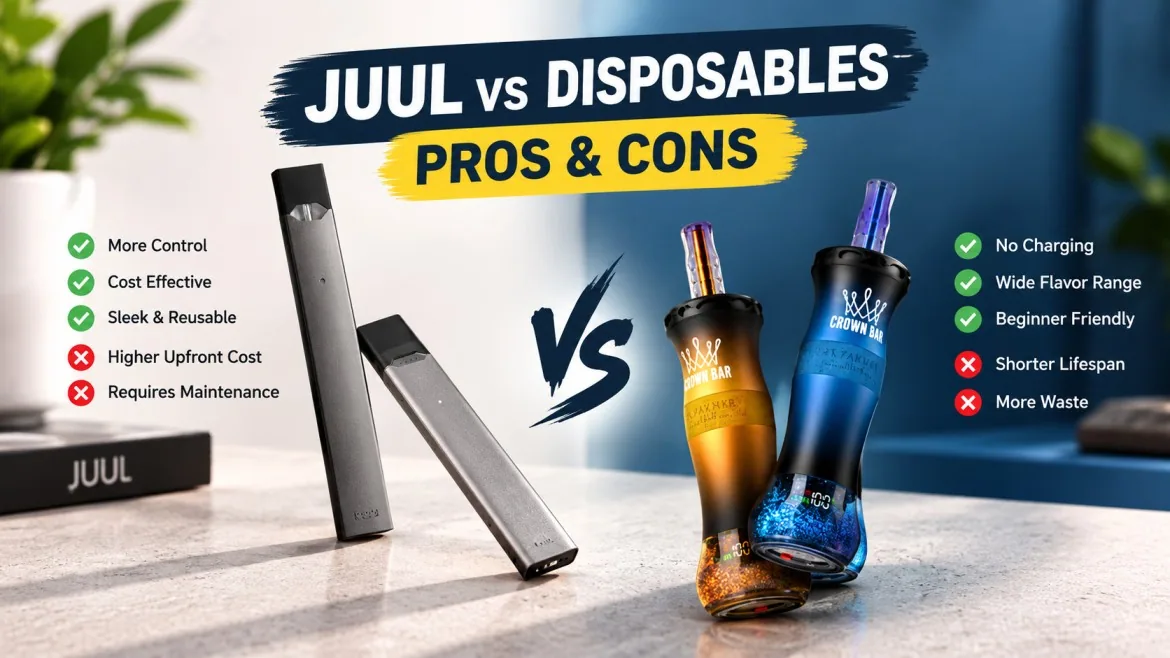
A JUUL device is a rechargeable device that works with compatible replacement pods, so you keep the hardware and swap out the consumable. A typical disposable vape builds the e-liquid, coil, and battery into one unit meant to be thrown away once it’s empty. That said, newer disposables now often come with USB-C charging, battery indicators, or liquid-level displays, which blurs the line more than it used to.
This comparison covers convenience, ongoing costs, maintenance, compatibility, waste, and nicotine considerations for both formats. The honest answer to “which is better” depends on the specific models, local pricing, and what you actually prioritize. If you’re new to vaping, it’s worth reading through some common mistakes new vapers make in the UAE before settling on either format.
JUUL vs. Disposable Vapes: What’s the Difference?
What Is JUUL?
JUUL runs on a rechargeable device-and-pod format. You buy the device once, then replace compatible prefilled pods rather than replacing the whole unit. Specifications and pod compatibility vary by model and market, so an original JUUL device isn’t identical to newer systems like JUUL 2. Don’t treat every generation as interchangeable before buying pods for a specific device.
What Is a Disposable Vape?
A disposable vape is usually an all-in-one design, with the e-liquid reservoir, coil, and battery built into a single device that gets discarded once it’s used up. Some modern disposables, including higher-capacity Al Fakher models, now include rechargeable batteries and USB-C ports. Worth being clear about: recharging a disposable’s battery doesn’t make its e-liquid reservoir or coil replaceable. The battery may get a second life, but the core consumable usually doesn’t.
The Main Difference Between the Two Formats
JUUL separates the reusable hardware from the consumable pod. A disposable keeps everything bundled into one unit, whether intended for disposal, charging port or not. That single distinction drives the differences in replacement routines, maintenance, running costs, and waste between the two, though individual models still vary quite a bit.
JUUL vs. Disposable Vapes: A Side-by-Side Comparison
| Comparison Factor | JUUL Pod System | Typical Disposable Vape |
|---|---|---|
| Basic design | Reusable device with compatible replacement pods | Integrated device intended for disposal |
| Charging | Rechargeable device | May be rechargeable or non-rechargeable |
| E-liquid replacement | Replace the compatible pod | Usually replace the entire device |
| Battery reuse | Reuse the device battery while functional | Depends on the model and its design |
| Maintenance | Charging and basic device care | Usually minimal routine maintenance |
| Running costs | Initial device plus replacement pods | Cost of replacement devices over time |
| Waste | Used pods and eventual device disposal | The integrated device and its electronic components |
| Compatibility | Depends on the device and approved pod format | Depends on the specific product |
| Availability | Depends on local distribution and regulations | Depends on local distribution and regulations |
These are typical patterns, not universal rules, so check the exact model before assuming it fits. A rechargeable disposable is still fundamentally different from a pod system as long as its reservoir and coil can’t be swapped out. Puff counts, nicotine delivery, and battery life aren’t directly comparable between brands just because the numbers on the box look similar.
JUUL Pros: Where a Pod System May Have Practical Advantages
You reuse the device instead of replacing it each time. You’re not discarding an entire battery and housing every time the e-liquid runs out. The device and battery still have a finite lifespan, depending on usage habits and charging patterns.
There’s a more defined replacement routine. Swapping a compatible pod is clearer and more predictable than replacing a whole disposable device, though this is a convenience around how replacement works, not a guarantee of longer overall use.
The device design is compact and straightforward. JUUL devices like the JUUL Slate, JUUL Silver, and JUUL 2 in Slate Grey use a simple, pocket-sized format with few parts to manage, though how compact it is compared to a specific disposable depends on the two products in question.
There’s a defined device-and-pod compatibility system. Closed-pod systems like JUUL 2 pods are built for specific devices, so checking compatibility before buying replacements matters. Some newer JUUL systems include pod authentication or age-verification features, though exact capabilities vary by model, so confirm against official manufacturer documentation rather than assuming. A security feature like this doesn’t independently prove a product is safe or approved for a given market.
Waste patterns may differ. Holding onto a functional device for longer can reduce how often you discard a whole unit compared to buying disposables repeatedly. That said, pod systems still generate waste from used pods and eventually need the device disposed of too.
JUUL Cons: What to Consider Before Choosing It
You need to recharge the device. A JUUL device depends on a working battery and access to a charger, whether that’s a JUUL 2 starter kit or an original model. A depleted battery with no charger nearby is an inconvenience disposables simply don’t have.
Replacement pods create an ongoing expense. The upfront device price isn’t the full cost of ownership. You’ll buy JUUL pods on a recurring basis, and shipping or local taxes can add to that. Prices and availability vary by market, so check current listings rather than assuming costs stay flat.
You have to check pod compatibility. Not every pod works with every device. Confirm the exact model number and official compatibility info before buying replacements, since restrictions can genuinely limit your options.
Product availability can be limited. Distribution, product authorization, and local regulations all affect what’s actually available. Check current regulatory status rather than relying on an old listing.
The device and pods still need proper disposal. Used pods and electronic components count as waste that needs handling correctly. A rechargeable device doesn’t eliminate environmental concerns, it just shifts where some waste happens.
Nicotine dependence and health risks remain. Nicotine is addictive, and e-cigarette aerosol can contain substances with potential health effects regardless of device format. Choosing a pod system over a disposable doesn’t change that, and device design alone doesn’t establish which format is comparatively safer. Credible guidance from the CDC is a more reliable reference than marketing material from either category.
Disposable Vape Pros and Cons: What JUUL Doesn’t Automatically Solve
Potential Advantages
The all-in-one format means little to no routine maintenance, and non-rechargeable models don’t require charging during their usable life. Some models, including larger-capacity options, now include rechargeable batteries and digital displays. If you’re coming from hookah, this look at why hookah smokers are switching to Al Fakher vapes covers that transition in more detail. Designs and specifications vary a lot between brands.
Potential Disadvantages
The integrated device is generally discarded once used up, and repeated replacements over weeks and months can add up to a higher cumulative spend than a one-time device purchase. Batteries and electronic components create real disposal challenges, and advertised puff counts don’t always match real-world use, since output depends on draw length, frequency, and habits.
Why a Rechargeable Disposable Is Not the Same as a Pod System
Charging a battery and replacing a liquid reservoir or coil are two different things. A rechargeable disposable extends battery life, but it doesn’t make the whole device reusable if the e-liquid chamber and coil are sealed in. Check the manufacturer’s actual design specifications rather than assuming a charging port means it works like a pod system.
Which Trade-Offs Matter Most?
That depends on what you weigh more heavily: maintenance effort, recurring purchases, compatibility, or waste. There’s no universal winner, it comes down to the specific models and how you actually use them.
Is JUUL Cheaper Than Disposable Vapes?
Based on current JUUL UAE listings, a JUUL device runs around 90 AED. Al Fakher’s Mega Max and Ultra models are priced around 50 AED each, while the higher-capacity Al Fakher E-Hose sits around 60 AED. These are starting points, and prices should always be confirmed at checkout since they can change.
Here’s a simplified 30-day illustration, built on the pricing above and a reasonable usage assumption, not a promise your own costs will match.
JUUL: Device cost of 90 AED, plus JUUL 2 pods at roughly 55 AED per pack (older JUUL 1 pods run closer to 90 AED). Assuming two pod packs across the month, that’s 90 + (55 × 2) = 200 AED for month one, dropping to around 110 AED in any following month.
Disposable: Assuming four Al Fakher Mega Max or Ultra devices across the month at 50 AED each, that’s 200 AED for the month, with no separate device cost. Someone using the higher-capacity E-Hose might only need two units at 60 AED each, bringing that down to 120 AED.
Total cost equals the initial device cost plus replacement consumables over your chosen period. For JUUL, that’s the device price plus the price per pod times the number of pods used. For a disposable, it’s the price per device times the number of devices used. Run your own numbers against your actual habits, since the example above is illustrative. Factor in shipping, local taxes, pod availability, charging accessories, and how your real usage compares to these assumptions, since prices referenced here reflect a single point in time.
Which Has More Nicotine: JUUL or Disposable Vapes?
Nicotine concentration, usually listed as a percentage or in mg/mL, tells you how concentrated the e-liquid is. That’s different from the total nicotine in a pod or device, which depends on liquid volume too. Neither number tells you exactly how much a person absorbs, since that depends on draw pattern and individual physiology. Labeling conventions differ between brands, so read carefully rather than assuming two products use the same system.
Formulation, device design, and usage patterns all affect nicotine exposure in ways a puff count doesn’t capture. It’s not accurate to assume JUUL or disposables inherently deliver more or less nicotine as a category, since this varies by specific product and user.
The product’s own label and official specifications are the most reliable source, not a puff-count comparison chart, and make sure you’re comparing products sold in the same market. For broader context, the CDC’s page on vaping health effects and the FDA’s overview of e-cigarettes and ENDS products are solid starting points.
Are JUUL Devices Better for the Environment?
Pod systems generally keep the main device in use while only the pods get replaced and discarded. An integrated disposable sends the whole unit, battery included, to the bin once it’s done. That’s a real structural difference, but a pod system still produces consumable waste and eventually needs the device disposed of too.
Batteries and electronic components need proper handling, not casual disposal. Ordinary household recycling generally doesn’t accept vape devices or used pods, so check local battery and e-waste collection points instead of regular trash. Used pods can still contain residual nicotine liquid, so handle them accordingly, and don’t attempt to dismantle, puncture, or modify batteries or devices yourself.
A real environmental comparison would need to account for materials, manufacturing, transportation, device lifespan, and end-of-life disposal across both formats, not just what gets thrown away at the point of use. Reducing how often you discard a whole device is plausible with a pod system, but that’s not the same as a proven reduction in total environmental impact.
How to Compare JUUL and Disposable Vapes Before Buying
Verify product legality and availability. Check applicable UAE regulations and confirm the specific product is lawfully marketed here, rather than assuming online availability equals approval.
Confirm authenticity and specifications. Use official manufacturer documentation and reliable retail sources to check the exact model, compatibility, battery design, and labeling.
Review the full cost, not just the shelf price. Compare upfront price and recurring consumable costs over the same timeframe.
Understand nicotine content and health warnings. Read the actual product label and consult credible public-health sources. Device features aren’t evidence of reduced health risk.
Check warranty, returns, and disposal information. Confirm these against the retailer’s actual stated policies rather than assuming standard terms apply. If discretion around nicotine use matters to you, there’s a useful guide on managing nicotine cravings in professional settings worth a look once you’ve settled on a device.
JUUL vs. Disposable Vapes: Frequently Asked Questions
Is JUUL better than a disposable vape?
It depends on the specific models, costs, maintenance, compatibility, and availability. Neither format is universally better.
Does JUUL last longer than a disposable vape?
The reusable device can last well beyond any single pod, while a disposable’s total lifespan depends entirely on its specific design and use.
Is JUUL cheaper than disposable vapes in the long run?
Based on current pricing, a JUUL device plus pods can land close to a month of disposables, sometimes slightly more, sometimes less, depending on how much you go through. Local prices and real usage decide the exact answer.
Are rechargeable disposable vapes reusable?
Not necessarily. Recharging the battery doesn’t make the integrated e-liquid reservoir or coil replaceable. Check the exact model’s specifications first.
Do JUUL devices produce less waste?
Replacing pods instead of a whole device changes the waste pattern, but it doesn’t automatically mean lower total environmental impact without a full lifecycle comparison.
Is JUUL safer than a disposable vape?
Device format alone doesn’t establish comparative safety. Both involve nicotine dependence and exposure to substances that can affect health.
Can you use any vape pod with a JUUL device?
No. Compatibility depends on the exact device and pod format it’s built for. Check official specifications before buying replacement pods.
Are JUUL products legal where I live?
Legal status depends on local laws and the relevant regulatory authority. Requirements vary by region and product, so check current regulations.
Can vaping help someone quit smoking?
Evidence on vaping as a cessation tool is mixed and depends on individual circumstances. This article compares consumer products, not personalized cessation advice, so anyone looking to quit should consult established cessation resources and a healthcare professional.
Final Takeaway: Compare the Trade-Offs, Not Just the Device
JUUL separates reusable hardware from a replaceable pod, while a typical disposable bundles everything into one unit meant for disposal, charging port or not. Charging needs, pod compatibility, replacement costs, waste, and availability all depend on the specific model, not the category as a whole. Upfront price alone doesn’t tell you which option costs less over time, and neither format should be assumed safer purely because of how it’s built.
Check official specifications, credible health information, and current local regulations before deciding. JUUL UAE lists verified specifications and current pricing for both JUUL devices and disposable options like Al Fakher Crown Bar Ultra 40K and Al Fakher Crown Bar E-Hose 60K, so you can compare real details before buying rather than going off a shelf price alone.
This product contains nicotine, an addictive chemical, and is intended for adult users only. Please vape responsibly and in line with local UAE regulations.
